
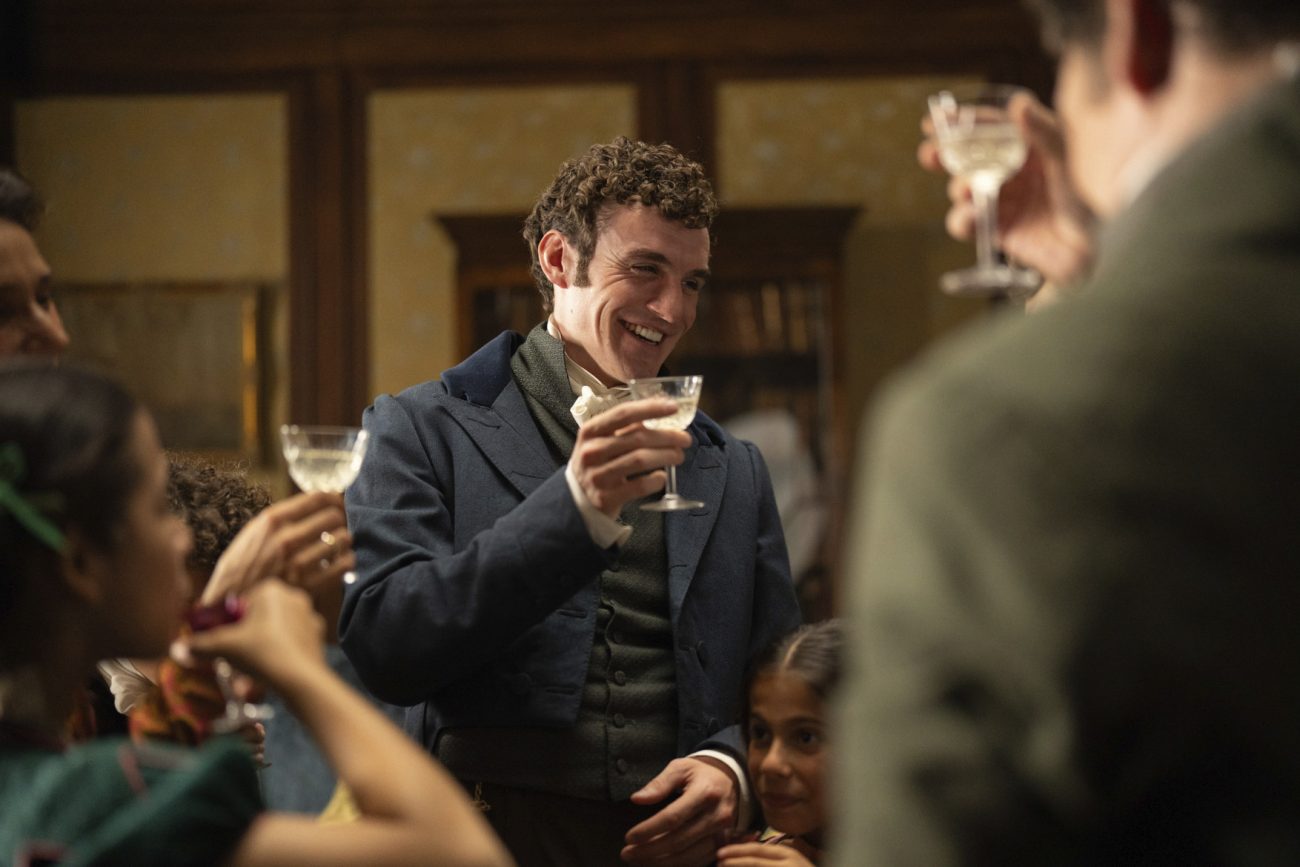
Series: The Other Bennet Sister
Episode: 10
Based on: The Other Bennet Sister by Janice Hadlow
Setting: Regency London
Main character: Mary Bennet
Mary Bennet has spent the series trying to discover where she belongs. In the finale, she finally finds the answer, but not before she confronts her mother, rejects William Ryder once and for all and demands that the man she loves stop making decisions on her behalf.
Mrs Bennet comes to London
Mary has written to Tom three times since leaving the Lakes. Every letter has been returned because his forwarding address is unknown. She resolves not to wallow. She will stay in London, find work and build a life for herself. Unfortunately, Mrs Bennet arrives.
Supposedly in London to consult a specialist about her nerves, she has another mission. Four daughters are married, and she intends to find a husband for the fifth. Mary protests that she is perfectly happy, but Mrs Bennet is having none of it.
William proposes
William Ryder arrives with surprising news. Lady Catherine de Bourgh has named him her heir. He told Tom about his changed circumstances in the Lakes and revealed his intention to propose to Mary.
Even more surprisingly, Tom gave him his blessing.
William now makes the proposal properly. Mary refuses.
She cares deeply about William and credits his friendship with teaching her about herself, but she does not love him as he deserves to be loved. Instead, she encourages him to go to Italy and pursue the adventurous life he wants.
Mrs Bennet, who has been listening, is horrified.
John Sparrow returns
Mary escapes into the London streets and encounters someone from her past: John Sparrow, the young man who danced with her at the Meryton assembly. He has achieved his ambition and qualified as a doctor.
John is married now and has a one-year-old daughter. Mary tells him she hopes to become a governess to an older girl and teach subjects such as geology and petrology.
Then John asks the question Mary has spent years avoiding. If she and her mother have always disagreed about what her life should be, why does Mary keep trying to please her?
“Our happiness is in our own hands,” Mary concludes.
At last, she believes it.
Mary confronts her mother
Mary returns home and refuses Mrs Bennet’s demand that she call William back. She will not marry a man she does not love.
When Mrs Bennet points out that Mary would once have accepted Mr Collins, Mary acknowledges how much she has changed. Charlotte once told her that the alternatives were marriage or misery. Mary now knows that isn’t true. She has seen miserable marriages and experienced great happiness while single. She intends to support herself as a governess.
The confrontation finally exposes something deeper in Mrs Bennet too. She had five daughters whose futures depended heavily on marriage, and she felt entirely responsible for securing them. Mr Bennet mocked her anxieties rather than helping.
For perhaps the first time, Mary understands the fear beneath her mother’s obsession with husbands. Mrs Bennet admits that she simply did not want Mary to be “left behind”.
They may never understand each other completely, but Mary no longer needs her mother’s approval.
Caroline Bingley does something kind
Caroline unexpectedly visits Mary. After thanking her for saving her on the mountain, Caroline makes an extraordinary request: she wants Mary to leave William alone.
Mary happily agrees. William is a dear friend, she explains, but they were never suited.
Then Mary finally says aloud what has become obvious. “It was always Mr Hayward for me.”
Unfortunately, Tom has disappeared. Caroline takes this information away with her.
Mary builds her own life
Time passes. Mary stays in London and becomes a governess. Gradually, she worries less about other people’s approval.
Her life is different from those of her sisters, but it is not inferior. She has work she enjoys, people she loves and a place within the Gardiner family.
Most importantly, Mary finally knows that she is “good enough”. And then someone starts shouting her name. Tom Hayward has returned.
“You can’t just say Yorkshire!”
Tom’s explanation for disappearing is wonderfully inadequate.
“Yorkshire.” Mary is furious.
Tom explains that William told him about his inheritance and his intention to marry Mary. He knew that William could offer her wealth and security, so he decided the honourable thing was to step aside.
Mary is appalled. Tom and William have effectively decided her future between themselves without asking what she wants.
Tom finally realises his mistake. He cannot offer Mary wealth or Italy, but he can offer his love, devotion and the hope of a family together.
Mary gives him the answer he should have asked for much earlier. She never loved William. She loves Tom.
Tom has loved Mary since he first caught her secretly playing Graces alone at the Gardiners’ house. He proposes, and Mary says yes.
Mary Bennet gets her happy ending
There is one final surprise. Tom only returned because Caroline Bingley wrote to him and revealed Mary’s feelings. Caroline has meanwhile departed for Italy in pursuit of William.
Mary and Tom marry, but Mary makes the real meaning of her story clear: marriage is “almost beside the point”.
She had to leave her family and experience the wider world before she could discover her own place within it.
In the final scene, Mary and Tom are choosing colours for their home. Tom admires what he thinks is indigo. Mary immediately corrects him: it is Tyrian purple, named for the ancient dye associated with the murex sea snail.
Mary Bennet may have changed enormously. Thankfully, she is still Mary Bennet.
Historical notes
Moorfields and medicine: Moorfields has an extraordinary medical history. John’s reference to Moorfields connects him with London’s long history of specialist eye treatment. The London Dispensary for Curing Diseases of the Eye and Ear was founded in 1805 and moved to Moorfields in 1822. It eventually developed into today’s Moorfields Eye Hospital.
Working as a governess: Mary’s plan to work as a governess offers independence, but not necessarily an easy life. Educated middle-class women could earn a living by teaching children in private households, but governesses occupied an awkward social position. They were neither servants nor social equals of the families who employed them. Mary’s determination to specialise in teaching older girls also reflects the widening ambitions for female education during the nineteenth century.
The origins of Tyrian purple: Tyrian purple really was made from sea snails. The extraordinarily expensive ancient dye was produced from secretions of several species of murex snail and became associated with royalty and elite status. The Hercules story Mary tells Tom comes from an ancient tradition in which Hercules’ dog discovers the dye after biting into a sea snail.
Where to watch The Other Bennet Sister
The Other Bennet Sister is available on BBC iPlayer in the UK, BritBox in the US and Canada, and BINGE and Foxtel Now in Australia. Availability varies in other countries.
