
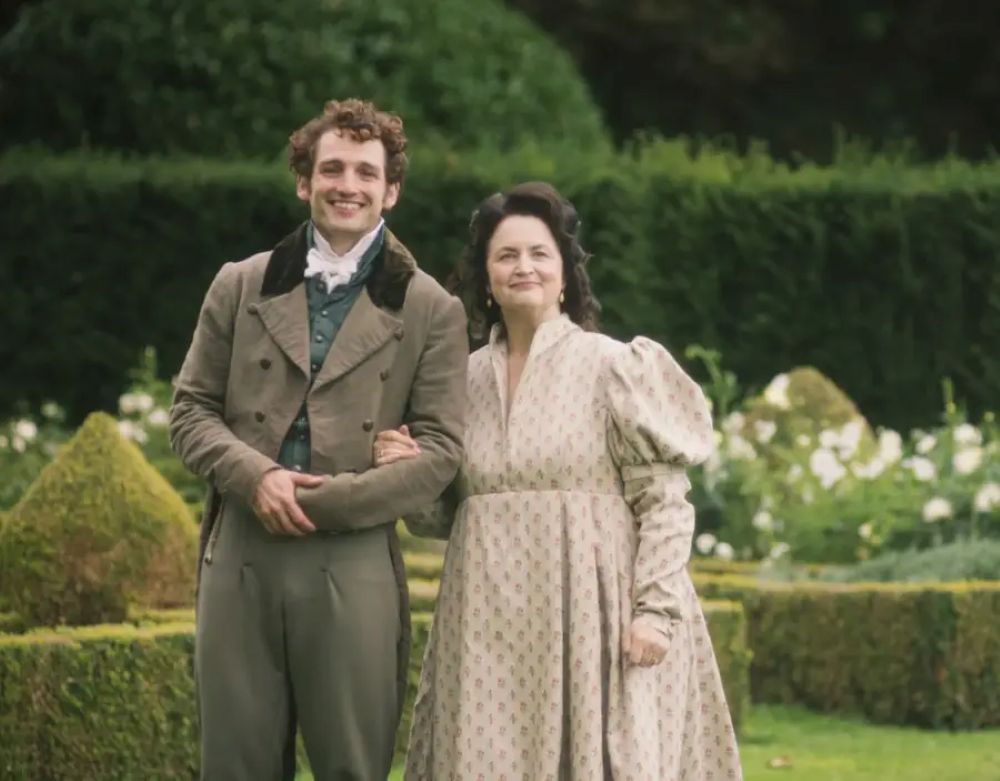
Series: The Other Bennet Sister
Episode: 6
Based on: The Other Bennet Sister by Janice Hadlow
Setting: Regency England
Main character: Mary Bennet
Mary rushes to Pemberley fearing that her mother is seriously ill. Instead, she finds Mrs Bennet remarkably healthy, and herself suddenly at the centre of the family’s romantic attention.
Mary returns to her family
After her hurried journey from London, Mary arrives at Pemberley exhausted and anxious. Mrs Bennet’s condition proves considerably less alarming than advertised. She is already well enough to criticise Mary’s complexion, hair and new dress before demanding that her daughter attend to her every need.
For Mary, the return is disorientating. In London she has made friends, changed her appearance and begun developing a life of her own. At Pemberley, her family still sees the old Mary. Even her suggestion that they play Graces is dismissed until Mary points out that the game is fashionable in London.
Mary confides in Elizabeth
Elizabeth notices that something is bothering her sister. Mary finally admits what happened at William Ryder’s supper. Caroline Bingley tried to humiliate her and, in her hurried departure, Mary smashed the bell jar containing William’s father’s beetle.
She is convinced she has made a fool of herself, but Elizabeth reassures her that other people rarely dwell on our embarrassing moments as much as we imagine they do ourselves.
Mary also tells Elizabeth about Ann Baxter and Tom Hayward, describing Tom as “the kindest man”. Elizabeth immediately senses something Mary herself seems reluctant to acknowledge. Then an unexpected visitor arrives.
William comes to Pemberley
William Ryder has travelled from London. He explains that he was concerned by Mary’s sudden departure and wanted to enquire after Mrs Bennet. He is also on his way to visit his aunt, who turns out to be none other than Lady Catherine de Bourgh.
Mrs Bennet’s interest is immediate. William joins the family for tea and reassures Mary that the broken bell jar does not matter. Mary, who assumed he had come to discuss the accident, slowly realises that he has something else entirely on his mind.
William openly praises her intelligence and lack of affectation. At dinner, he tells the family that London has been “a little grey” without Mary.
For once, Mary is the Bennet sister attracting everyone’s attention.
The pursuit of joy
The following day, Mary finds William pretending to read a book upside down. Their conversation turns to his late father, a scholar who devoted his life to studying insects. William remembers how little time his father spent with his family and how suddenly he died.
The experience shaped William’s philosophy. Rather than devote himself to study, duty and rules, he has decided to pursue happiness. Then he asks Mary a deceptively simple question: what makes her happy?
Mary struggles to answer. Nobody has ever asked her before. She eventually names reading, learning and teaching. William adds friendship and love.
Wordsworth and a declaration
William persuades Mary to go riding despite her dislike of horses. During their outing, he returns to his favourite argument: people should say what they truly think instead of hiding behind politeness.
Then he puts his philosophy into practice.
William recites Wordsworth’s She Dwelt Among the Untrodden Ways, comparing Mary to the poem’s overlooked young woman; a violet hidden beside a stone and a solitary star. Mary initially objects to his interpretation. She wasn’t literally isolated growing up.
But William explains that he means something deeper. Surrounded by her beautiful and admired sisters, Mary was hidden from view. Now that she has ventured into the world alone, people can finally see her. The words affect her profoundly.
Is William about to propose?
Back at Pemberley, Mary’s sisters immediately demand to know what happened. Mrs Bennet has reached her own conclusion: William is eligible, wealthy and plainly interested. She believes a proposal is imminent and makes Mary promise that she will accept him.
Mary isn’t nearly so certain. But William soon asks to speak with her privately. He has something important to say, and Mary remembers her mother’s warning to prepare herself.
Whatever happens next, Mary Bennet is no longer the sister nobody expects to marry.
Historical notes
Wordsworth’s “Lucy” poems: William chooses one of Wordsworth’s famous “Lucy poems”. She Dwelt Among the Untrodden Ways was written during Wordsworth’s years in Germany and first appeared in the second edition of Lyrical Ballads in 1800. Its mysterious Lucy is an obscure, largely unnoticed woman whose true value is recognised by the speaker — making William’s choice for Mary anything but accidental.
The fashion for natural history: Natural history could become an all-consuming gentlemanly pursuit. William’s father’s obsession with beetles fits a period in which collecting and classifying plants, insects, shells, minerals and fossils became increasingly fashionable. Entomology developed rapidly in Britain during the early nineteenth century, and wealthy amateurs made important contributions alongside professional naturalists.
Courtship and country-house visits: A gentleman visiting a woman at her family’s country house would attract attention. William’s journey to Pemberley is why Mary’s sisters immediately become suspicious. Courtship took place within a heavily observed social world, and a gentleman going conspicuously out of his way to visit an unmarried woman could easily be interpreted as evidence of serious intentions.
Where to watch The Other Bennet Sister
The Other Bennet Sister is available on BBC iPlayer in the UK, BritBox in the US and Canada, and BINGE and Foxtel Now in Australia. Availability varies in other countries.
